Trakheesi permits: what a Dubai property advert needs
Every Dubai property advert needs a Trakheesi permit. What the advert must show, the QR code, off-plan details, photos, how ads are checked, and the fines.
On this page
Every property advert in Dubai needs an advertising permit from the Dubai Land Department (DLD), issued through its online Trakheesi system before the advert runs, and the advert must show the permit number. It must also name the brokerage and carry the permit's QR code, and it may contain nothing the permit did not approve. Off-plan adverts add the developer, project and escrow details.
Key points
- Every Dubai property advert, on a portal, in print or on social media, needs a permit from the DLD's Trakheesi system and must show its number.
- It must also name the brokerage and carry the permit's QR code from the DLD's Madmoun service, required since 24 April 2023.
- An off-plan advert must add the developer, the project's name, number and location, and the escrow account number.
- The advertising company is "responsible for the validity and credibility of the advertisement content", and the advert may contain nothing the permit did not approve.
- We found no Dubai rule on staged or edited photos. The published fines, from AED 50,000, are for permit breaches.
What is a Trakheesi permit?
It is the DLD's approval to advertise a particular property. Trakheesi is the online system that the Real Estate Regulatory Agency (RERA), the DLD's regulatory arm, uses for broker licences, advertising permits and violations.
Brokerages "must obtain a permit for any real estate advertisement or marketing material through the Trakheesi system", says RERA's Real Estate Brokerage Practice Guide (opens in a new tab) (November 2024). Bayut's Trakheesi guide (opens in a new tab) adds that a listing needs one to go live on Bayut or Dubizzle.
To apply, a broker attaches "A copy of the advertisement form" and the marketing contract with the owner, says the DLD's Real Estate Ad Permit service page (opens in a new tab). The Practice Guide calls that contract Contract A, "An agreement to market a property between the seller and the real estate brokerage", and Bayut calls it Form A. Bayut's guide also accepts "an NOC from the legal owner" (a no-objection certificate), and lists what the application records: the unit's details from the title deed, whether it is for rent or sale, and a price range.
What must a Dubai property advert show?
The permit number, the brokerage's name and the QR code on every advert, and five project details on an off-plan one. The core text is RERA's Circular 2-2022 (opens in a new tab) (20 July 2022), addressed to every company marketing property "through various advertising channels, including real estate platforms or social media".
| Requirement | Applies to | Source |
|---|---|---|
| The permit number | Every advert | Circular 2-2022, item 1 |
| The brokerage's name | Every advert, "whether written or visual" | Circular 2-2022, item 2 |
| The permit's QR code | Every advert, "whether visual or written" | DLD, 24 April 2025 |
| Developer, project name, number and location, escrow account number | Off-plan projects | Circular 2-2022, item 3 |
| Nothing "that has not been approved in the permit" | Every advert | Circular 2-2022, item 4 |
| A promotional campaign permit | Adverts offering discounts, fee exemptions or free extras | Circular 2-2022, item 5 |
What is the QR code on a listing?
It is the permit's own code from the DLD's Madmoun service, which Dubai adverts have had to carry since 24 April 2023. The DLD announced it on 18 April 2023 as a QR code "issued for any real estate advertisement permit" (Government of Dubai Media Office (opens in a new tab)).
Scanning it lets a buyer "get a glimpse of the property's authorised details and establish if it has been sold or rented". The DLD's website gives the advert's full information, "including details about the advertising company, the property's condition and specifications". So a buyer can set what the permit says beside what your advert shows.
What extra does an off-plan advert need?
An off-plan property is one sold before it is built. Its advert must include "the developer's name, project name, project number, project location and approved escrow account number" (Circular 2-2022, item 3).
The Practice Guide also asks the broker to check that the project is licensed and registered with RERA and has an escrow account, and to hold a marketing contract with the developer. Until there are rooms to photograph, the pictures are renders. Our comparison of virtual staging and 3D rendering covers when to use which.
What does the permit mean for your photos?
The DLD's published rules say nothing about staged or edited photos. They do require the advert to match its permit, so in practice every photo, staged or not, should be of that unit and show it as it is.
Two lines still reach photos: Circular 2-2022's duty of "validity and credibility", and RERA's Circular 3-2022 to the portals (opens in a new tab) (2 August 2022): "The real estate advertising information must reflect the information of the permits issued by RERA." The application carries "A copy of the advertisement form", and Bayut's guide has agents upload the photos to a listing draft and screenshot its advertising form before applying. Neither says what the DLD's reviewer checks.
Our reading:
- This unit only. No show flat, no other unit in the building, no developer render for a resale unit. Property Finder's checklist for Verified listings (opens in a new tab) already says "Computer-generated (CGIs) or developer images won't be approved".
- The room as it is. Furniture added to a photo leaves the property unchanged. A new floor or a better view changes what is advertised.
- Labelled, with the original. Label each staged photo and keep the as-photographed one in the listing.
- Staged before you apply. Then the copy you attach shows the photos buyers will see.
You may have read that the DLD requires a watermark on staged photos. An undated PropertyNews.ae report (opens in a new tab) describes a "True-View" framework requiring "a verified watermark", and West Gate Real Estate's blog (opens in a new tab) (7 June 2026) says the DLD's 2026 guidelines require a "Digitally Enhanced" watermark. The two describe different rules, neither links a DLD document, and we found nothing on the DLD's website that confirms either. Our tracker of virtual staging disclosure rules and what Bayut and Property Finder say about staging cover the rules that do exist.
How does the DLD check property adverts?
At four points: the application, the portals' link with RERA, the DLD's AI platform and inspections.
- The application. "An employee will review and approve the request", says the DLD's service page, which expects it to take one working day.
- The portals. Circular 3-2022 requires each permit to be "verifiable through the integration between RERA and the real estate portals", and portals must delist properties no longer available or mark them sold, or risk "blocking or stopping the site from publishing real estate ads".
- The AI platform. On 24 April 2025 the DLD said (opens in a new tab) its Real Estate Advertising Governance Platform had "monitored over 279,000 real estate advertisements" on Property Finder, Dubizzle and Bayut, and that "29% of the monitored listings were automatically modified using artificial intelligence". Gulf News (opens in a new tab) reported the same figures that day, counted from October 2024. Neither says what was changed.
- Inspections. In the first half of 2024 the DLD carried out 1,530 inspections of adverts, issued more than 1,200 legal warnings and fined 256 brokers (Dubai Media Office, 17 July 2024 (opens in a new tab)).
We found no published procedure for an advert that does not match its permit. The DLD's platform may change the listing, and Circular 2-2022 warns: "Violations will be issued to any company that does not comply with these terms and conditions."
What is the fine for advertising without a permit?
At least AED 50,000, doubled for a repeat. RERA's Circular 1-2020 (opens in a new tab) (17 May 2020), on advertising without a permit, misused permit numbers and unapproved promotional campaigns, says "the value of the violation is not less than AED 50,000, and in the event of a repeat violation, the value will be doubled."
In October 2020 the DLD fined 10 companies and warned 30 (opens in a new tab) for advertising without permits, misusing permit numbers and using expired permits. It described each fine as "a progressive AED 50,000" and said it "may reach the stage of cancelling the licence". We found no published fine for an advert's photos.
Do Abu Dhabi property adverts need a permit?
Yes, under its own system. According to law firm Al Tamimi & Company (opens in a new tab) (4 September 2025), the Abu Dhabi Real Estate Centre (ADREC) has made its Madhmoun platform mandatory for adverts of on-shore property for sale or rent, and "Every online property advertisement must now obtain an advertising permit through ADREC's services portal, DARI, before going live", once ownership, description and size are checked against the title deed. Madhmoun is a different system from Dubai's Madmoun QR code, and ADGM, the financial free zone on Al Maryah and Al Reem islands, issues a permit of its own.
A checklist before you publish an advert
- Contract. Contract A, or the owner's NOC, in place before you apply.
- Permit. For this unit, for sale or rent as advertised, and not expired.
- On the advert. The permit number, this permit's QR code (test that it scans) and the brokerage's name.
- Off-plan. Developer, project name, number and location, escrow account number.
- Details. Unit, purpose and price as the permit records them, and nothing it did not approve.
- Offers. A promotional campaign permit for discounts, fee waivers or free extras.
- Photos. This unit only, staged photos labelled, originals kept, the property itself unchanged.
- Every copy. Social media, your website and print carry the same as the portals.
- After the deal. Take the advert down or mark it sold.
Common questions
Does a social media post need a permit?
Yes. Circular 2-2022 names "real estate platforms or social media" among the channels it covers, so a post needs the permit number, brokerage name and QR code like any portal listing.
How long does a Trakheesi permit last?
We found no standard term published by the DLD. Its Trakheesi user manual (opens in a new tab) (2025) has the applicant "Enter start and expiry date of the permit" and includes a renewal request, so check each permit's expiry date in Trakheesi. Using an expired permit was one of the breaches fined in 2020.
How much does a Trakheesi permit cost?
AED 1,000 for most permits and AED 5,000 for a project launch event, plus an AED 20 knowledge and innovation fee, according to the DLD's service page.
Does the permit number have to go on the photos?
On a portal listing, no rule we found asks for it: Bayut's guide has the number typed into the listing, and Property Finder's Verified checklist asks for images with "no footers" (see our Property Finder and Bayut photo requirements). A brochure or a billboard is itself the advert, so the permit number, the brokerage's name and the QR code go on it.
Staging photos for a permitted advert
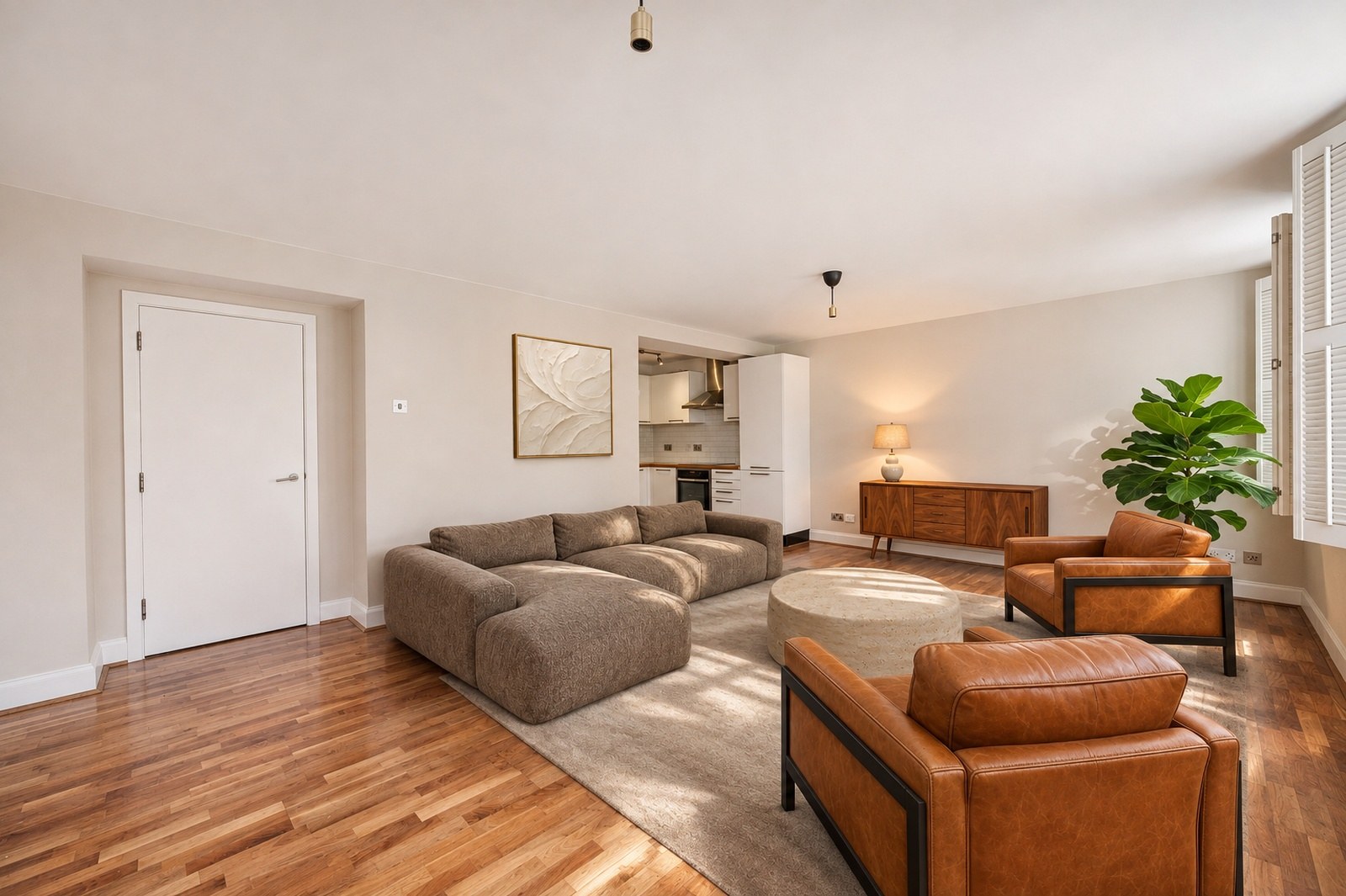
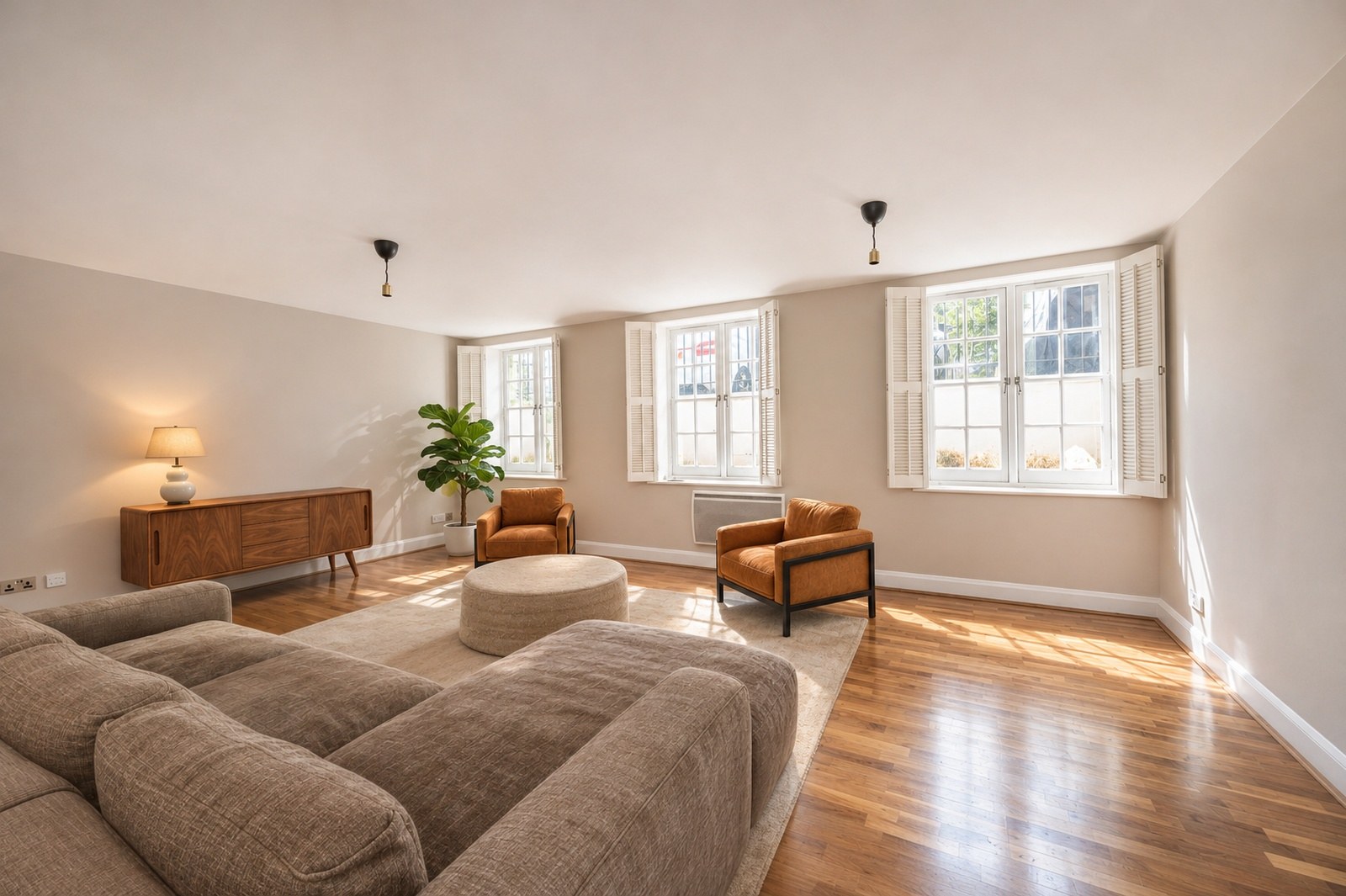
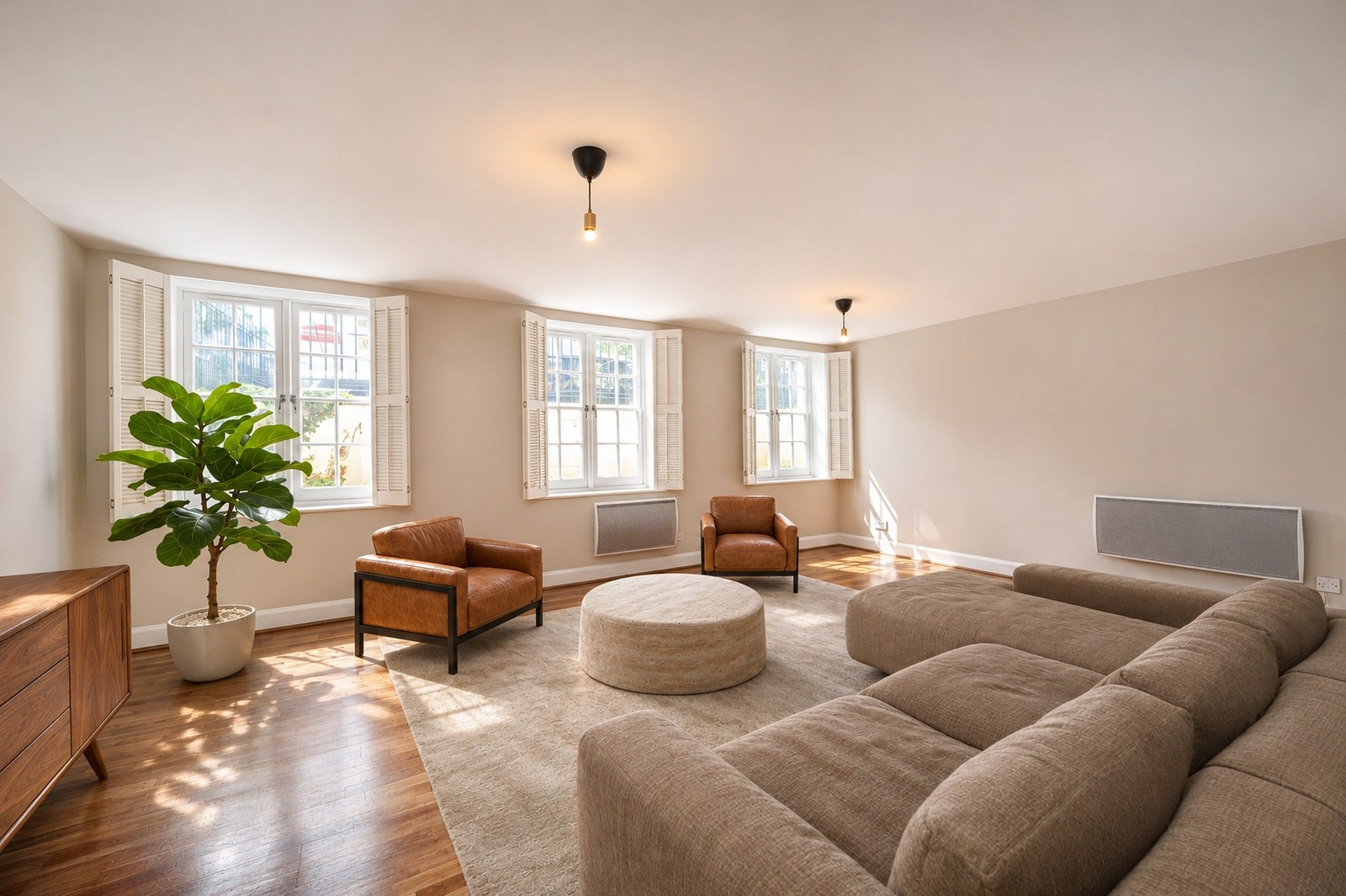
For an empty unit, see our guides to selling a vacant apartment in Dubai and to virtual staging in Dubai. Livium AI, which we make, stages living rooms and bedrooms from ordinary photos, with the same furniture in the same place in every photo, and each staged photo downloads with a "Virtually staged" label or without one. You can start with 25 free credits.
Stage the room once.
Every photo matches.
Upload a few photos of the empty room. Livium AI furnishes it once, in one 3D model with every piece at its real size, so every photo of the listing shows the same furniture in the same place.
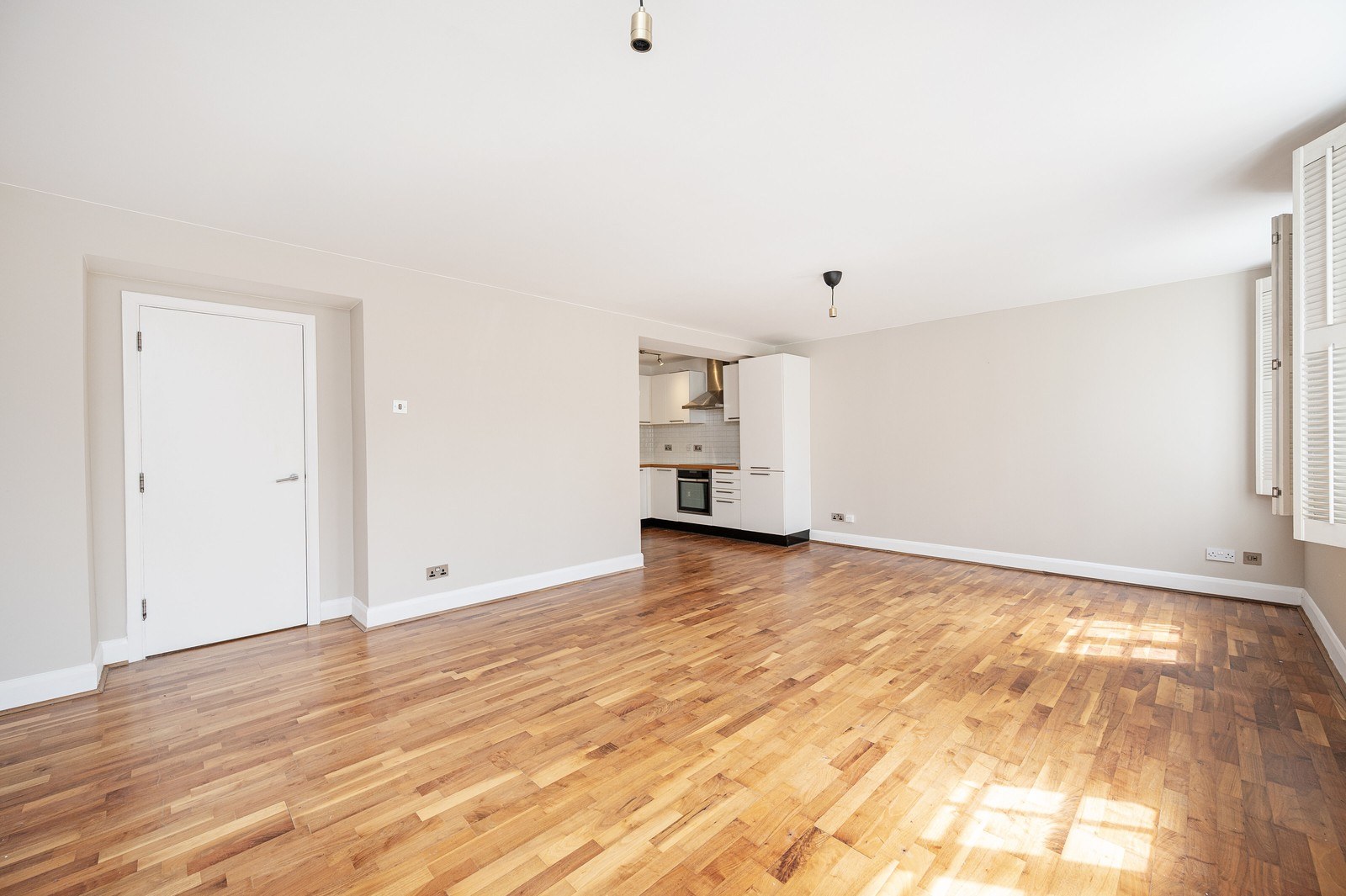 As photographedStaged by Livium AI
Sources
All links last checked on 16 November 2026.
- Circular 2-2022: Real Estate ads terms and conditions (opens in a new tab), RERA, Dubai Land Department, 20 July 2022
- Circular 3-2022: Terms and conditions for real estate marketing on portals (opens in a new tab), RERA, Dubai Land Department, 2 August 2022
- Circular 1-2020: Real Estate Advertising and Promotional Campaigns (opens in a new tab), RERA, Dubai Land Department, 17 May 2020
- Real Estate Brokerage Practice Guide, second edition (opens in a new tab), RERA, Dubai Land Department, November 2024
- Real Estate Ad Permit service page (opens in a new tab), Dubai Land Department, undated
- Trakheesi User Manual 2025 (opens in a new tab), Dubai Land Department, 2025
- Dubai Land Department provides Madmoun service to verify validity of real estate ads via QR codes (opens in a new tab), Government of Dubai Media Office, 18 April 2023
- Dubai Land Department strengthens transparency with AI-enabled real estate advertising governance (opens in a new tab), Dubai Land Department, 24 April 2025
- Dubai property ads: Land Department gets AI to correct listings (opens in a new tab), Gulf News, 24 April 2025
- Dubai Land Department fines 256 brokers for failing to comply with advertising terms and conditions over the past six months (opens in a new tab), Government of Dubai Media Office, 17 July 2024
- DLD fines 10 real estate companies and warns another 30 for not adhering to advertising requirements (opens in a new tab), Government of Dubai Media Office, 20 October 2020
- Complete Guide to the Trakheesi System in Dubai (opens in a new tab), Bayut, updated 16 November 2026
- Verified listing: fact sheet and checklist (opens in a new tab), Property Finder, PDF, undated
- Abu Dhabi real estate: new transparency policies introduced by ADREC and ADGM (opens in a new tab), Al Tamimi and Company on Legal 500, 4 September 2025
- Dubai Mandates Verified Accuracy for Virtual Property Tours (opens in a new tab), PropertyNews.ae, undated
- Home Staging in Dubai: Does it Increase Sale Price? (opens in a new tab), West Gate Real Estate, 7 June 2026
General information, not legal advice: rules change, so check the ones that apply to your listing.
Keep reading
How to sell or let a vacant apartment in Dubai
Selling or letting an empty flat in Dubai: the permit and owner's form, preparing and photographing the unit, staging options, and a checklist for the week.
Real estate photography cost in Dubai (2026 prices)
Real estate photography in Dubai costs about AED 350 to 800 for a one-bedroom on five studios' own price lists. Add-on prices, and what to ask before booking.
Home staging cost in Dubai: physical vs virtual
What home staging costs in Dubai: physical staging, furniture rental, studio virtual staging and software, priced in dirhams on one vacant one-bedroom.