Virtual staging in Dubai: a guide for agents (2026)
Virtual staging in Dubai: what it costs in dirhams, what the DLD and the portals say about it, how to do it honestly, and when to leave it out.
On this page
Virtual staging adds furniture to photographs of a real, empty room. We found no rule from the Dubai Land Department (DLD), its Real Estate Regulatory Agency (RERA), Bayut or Property Finder that bans it or says how to label it. Software costs a few dirhams a photo and a studio AED 200 to 500 an image, against AED 5,000 or more to stage a one-bedroom with rented furniture. The advert still needs a Trakheesi permit (the DLD's advertising permit) and must be accurate, so label each staged photo and keep the original in the listing.
Key points
- Virtual staging adds furniture to a photo of a real room. Changing the walls, floor, windows, fittings or view is not staging.
- On 16 November 2026 we found no published rule from the DLD, RERA, Bayut, Property Finder or Dubizzle that bans virtual staging or requires a label.
- Every Dubai property advert needs a Trakheesi permit, and RERA makes the advertising company "responsible for the validity and credibility of the advertisement content".
- Indicative prices, checked November 2026: AED 200 to 500 an image from a Dubai studio, AED 5,000 to 10,000 to stage a one-bedroom physically for two to three months, and AED 1.47 to 9.80 a photo on two software tools, one of them ours.
- Label every staged photo, keep its original in the listing, and compare the two before you publish.
What is virtual staging?
Virtual staging is a photograph of a real room with furniture and decor added digitally. The room stays as photographed: walls, floor, windows, doors, built-in wardrobes, light fittings and the view.
It is not a 3D render (CGI), which is built from plans, usually before a unit exists, and is how off-plan projects (sold before completion) are marketed. Our comparison of virtual staging and 3D rendering explains when you need which. Nor is it virtual renovation, which changes the property itself, such as a new floor or kitchen, so the picture no longer shows what is for sale.
Why use virtual staging in Dubai?
It is a large market with a lot of agents in it. The Dubai Media Office reported (opens in a new tab) "over 270,000 transactions worth AED 917 billion, up 20% year on year" for 2025 (12 January 2026). The DLD counted (opens in a new tab) 32,294 registered brokers and 9,785 brokerage offices at the end of 2025 (9 March 2026). Empty rooms are the other reason: Bayut's guide to listing photos (opens in a new tab) notes that "Empty space is a problem largely faced by owners of newly built properties."
We found no independent study that measured whether virtual staging makes a listing sell or let faster, or for more, in Dubai or elsewhere.
What does virtual staging cost in Dubai?
Software costs a few dirhams a photo, a studio a few hundred dirhams an image, and physical staging of a one-bedroom several thousand. The prices below are indicative and were checked in November 2026. We sell one of the options.
| Option | Indicative price | Source |
|---|---|---|
| Physical staging of a one-bedroom, rented furniture for two to three months | AED 5,000 to 10,000 | Real Estate Club Dubai, June 2026 |
| Furniture rental package, studio to three-bedroom | AED 2,000 to 8,000 a month | Real Estate Club Dubai, June 2026 |
| Virtual staging by a studio | AED 200 to 500 an image | Real Estate Club Dubai, June 2026 |
| Virtual staging software | About AED 1.47 to 9.80 a photo | Virtual Staging AI and Livium AI, November 2026 |
The first three rows come from the Real Estate Club Dubai directory page on furniture and home staging (opens in a new tab) (updated June 2026), a directory that charges businesses to be listed and passes enquiries to partners. Quotes vary: the same site's Dubai furniture and home staging guide (opens in a new tab) gives AED 3,000 to 8,000 a month to rent staging furniture for a one-bedroom, and West Gate Real Estate's blog (opens in a new tab) (7 June 2026) puts staging a one- or two-bedroom for resale at AED 12,000 to 25,000. Get two quotes.
For software, Virtual Staging AI (opens in a new tab) lists $16 a month for six photos and $39 a month for 60 on yearly billing, about AED 9.80 and AED 2.40 a photo. At the time of writing our own plans are $19.99 a month for 40 staged photos (about AED 1.84 each) and $39.99 a month for 100 (about AED 1.47 each).
For a one-bedroom with five photos to stage, that is about AED 7 to 49 with software, AED 1,000 to 2,500 with a studio and AED 5,000 to 10,000 physically. Software is sold as a plan or a pack, so the cash you spend is its price: about AED 73 a month for our smaller plan, which covers 40 staged photos, or about AED 18 for our starter pack of 50 credits, ten photos, on a first purchase.
The photographer is extra: an apartment set of 10 to 25 edited images costs AED 350 to 1,500, says the same directory's photography price guide (opens in a new tab) (June 2026). Our comparison of staging costs in Dubai goes through each option in detail.
Is virtual staging allowed in Dubai?
We found no rule that bans virtual staging or says how to label it. The general advertising rules apply, and a staged photo is part of the advert.
Trakheesi is the DLD's online system for broker licences and advert permits. RERA's Real Estate Brokerage Practice Guide (opens in a new tab) (November 2024) says brokerages "must obtain a permit for any real estate advertisement or marketing material through the Trakheesi system" and that "the permit number must be displayed on the ad". Its permit types include electronic and classified ads, and Bayut's Trakheesi guide (opens in a new tab) confirms the permit is needed for a listing to go live on the portals.
The rule closest to photos is RERA's Circular 2-2022 on terms and conditions for property ads (opens in a new tab) (20 July 2022), which covers ads on "real estate platforms or social media". It makes the advertising company "responsible for the validity and credibility of the advertisement content" and bars "any information that has not been approved in the permit". It does not mention photographs, editing or staging. Real Estate Club Dubai, checking separately, also "found no public statement from Property Finder, Bayut or RERA setting out a formal disclosure rule" (4 August 2026 (opens in a new tab)).
Our reading: furniture added to a photo of the real room leaves the property unchanged, as long as nobody could take the furniture for part of the deal. That is what the label is for. A photo that changes the room itself, such as a different floor or a better view, no longer shows the property you are advertising, and your brokerage answers for what the ad shows.
You may have read that the DLD now requires a watermark on staged photos. An undated PropertyNews.ae report (opens in a new tab) describes a "True-View" framework requiring "a verified watermark", and West Gate's blog says the DLD's 2026 guidelines require a "Digitally Enhanced" watermark on staged photos. The two describe different rules, neither links a DLD document, and we found nothing on the DLD's website that confirms either. Our tracker of virtual staging disclosure rules lists the rules that do exist, with a link to each.
Do Bayut and Property Finder accept virtually staged photos?
We found no rule on either portal against virtually staged photos, and both portals' own guides suggest using it. Property Finder's staging advice for Dubai sellers (opens in a new tab) (27 August 2025) says "You can still grab attention by using virtual staging technology". Bayut's guide for agents on staging a home (opens in a new tab) (26 May 2023) calls it "much cheaper than physically staging a space" and warns that with AI "there are chances of the perspectives getting skewed". Neither says anything about labelling. One document to know about: Property Finder's checklist for Verified listings asks that "All images are genuine images of the property" and says computer-generated images (CGIs) will not be approved. It does not say whether a real photograph with furniture added counts as one, which is a good reason to keep the as-photographed version in the listing too. Our guide to Property Finder and Bayut photo requirements quotes it in full.
What the portals do act on is misleading listings: Property Finder says it (opens in a new tab) "uses AI-driven nightly sweeps that remove thousands of duplicate or misleading listings every day" (20 November 2025). We found no Dubizzle rule either. Our article on whether Bayut and Property Finder allow virtual staging sets out what each portal says.
How do you virtually stage a listing well?
Photograph the room properly, use the same furniture in every photo of it, check each result against its original, then publish it labelled with the original beside it.
- Shoot the room properly. Photograph each room from two or three corners, with the lights on, the blinds open and the camera level so walls stay upright. Bayut's photo guide (opens in a new tab) warns that "a wide-angle lens generally distorts the sizes of objects in the picture". A staged photo is no better than the photo under it. Our guide to photographing a room for staging covers the shots to take.
- Use the same furniture in every photo of a room. Buyers flip between photos, and a sofa that changes from one to the next makes a listing look fake. Livium AI builds one 3D model of the furnished room, with every piece at its real size, and renders it from each photo's camera position, so every photo shows the same furniture in the same place, and an AI image model then paints the final photos. Our guide to multi-angle virtual staging explains the methods and how to test any tool.
- Check each staged photo against its original. Compare what belongs to the property: walls, columns, windows, doors, floor, built-in wardrobes, air-conditioning grilles, light fittings and the view. In Dubai a view can be part of the price, so confirm the staged photo shows the real one, and watch for furniture so small it makes the room look bigger. Our list of common virtual staging mistakes shows what to look for.
- Label it. Put "Virtually staged" on the photo or in its caption, and a line in the description such as: "This image has been virtually staged: the furniture and decor were added digitally and are not included with the property." Our disclaimer wording for staged photos has more versions.
- Keep the originals in the listing. Add the empty photo of each staged room, ideally straight after the staged one, so nobody arrives at a viewing surprised.
When should you not use virtual staging?
When the photo would show the buyer something they will not get, or when the furniture is part of what is on offer.
- Off-plan units that do not exist yet. There is no room to photograph, so you need a render, presented as one.
- Rooms already furnished well. Staging them adds a cost and a label for nothing.
- Kitchens and bathrooms. Their fittings are part of what is for sale. Leave them as photographed.
- Anything that hides the property's condition. A rug over a damaged floor misleads the buyer. Real Estate Club Dubai's photography guide (opens in a new tab) warns that using staging to hide defects "crosses from marketing into misrepresentation".
- Furnished lets. If the furniture comes with the tenancy, photograph that furniture.
- A seller who wants the flat furnished for viewings. As the same guide puts it, virtual staging "only improves the listing, not the viewing." Buyers who visit will walk into an empty flat.
A worked example: one living room, two angles
This is one room, photographed empty for a listing and then staged from two camera positions: a flat's living room with a parquet floor, three tall shuttered windows and an open kitchen.
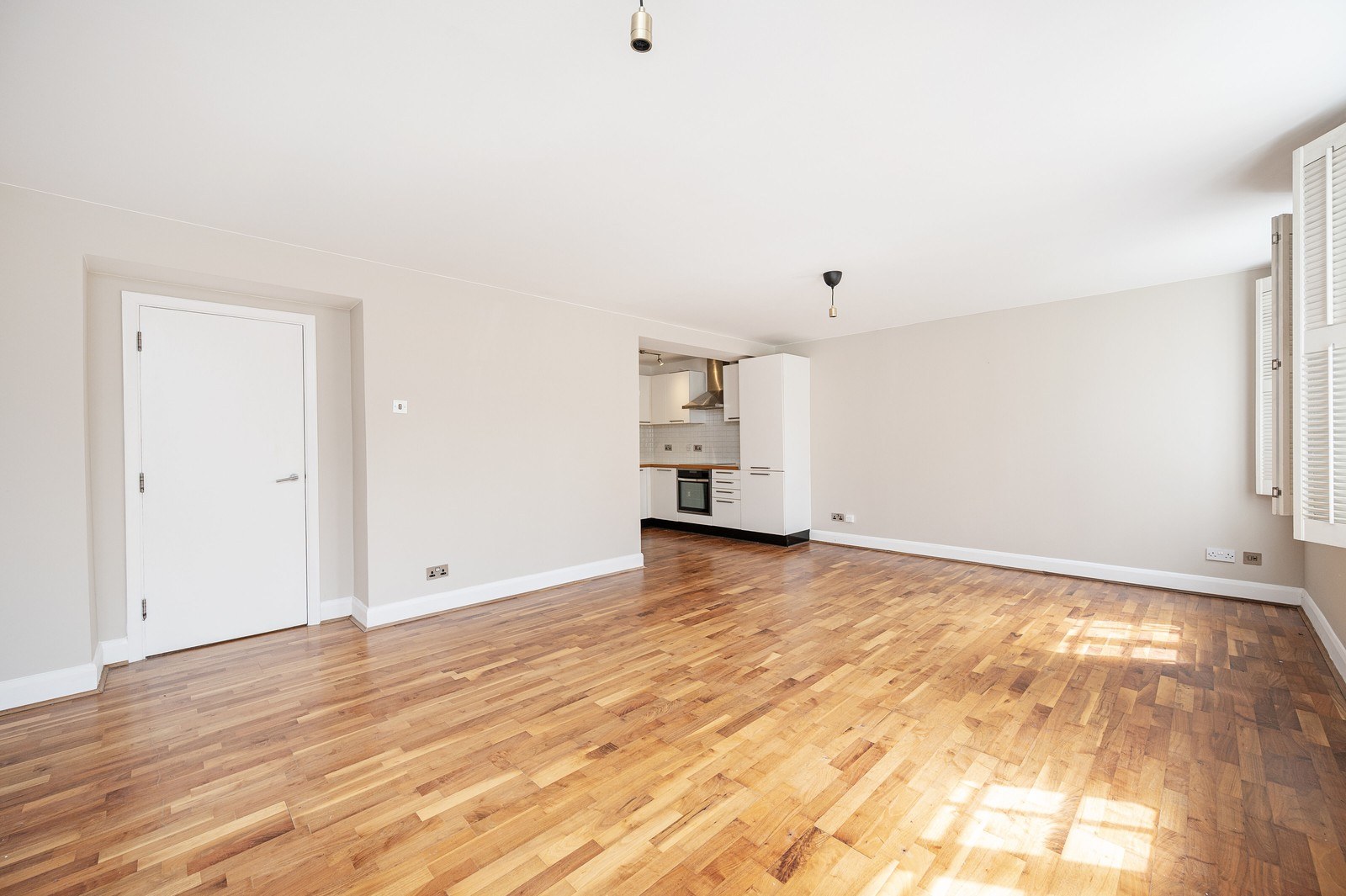
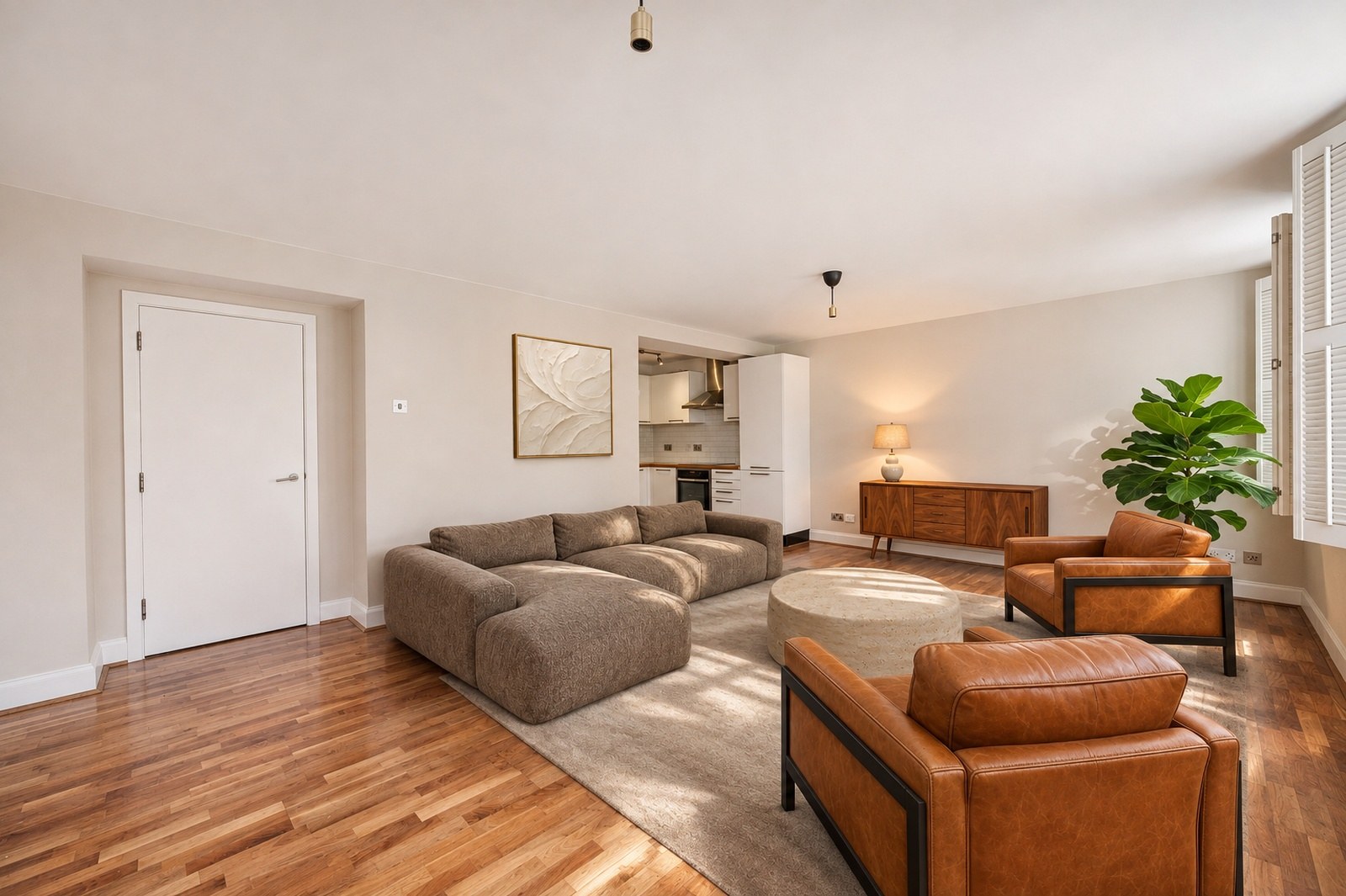
The furniture is a taupe sofa with a chaise, two cognac leather armchairs, a round pale coffee table, a walnut sideboard with a lamp and a fiddle-leaf fig on a pale rug, with a picture added on the wall beside the kitchen.
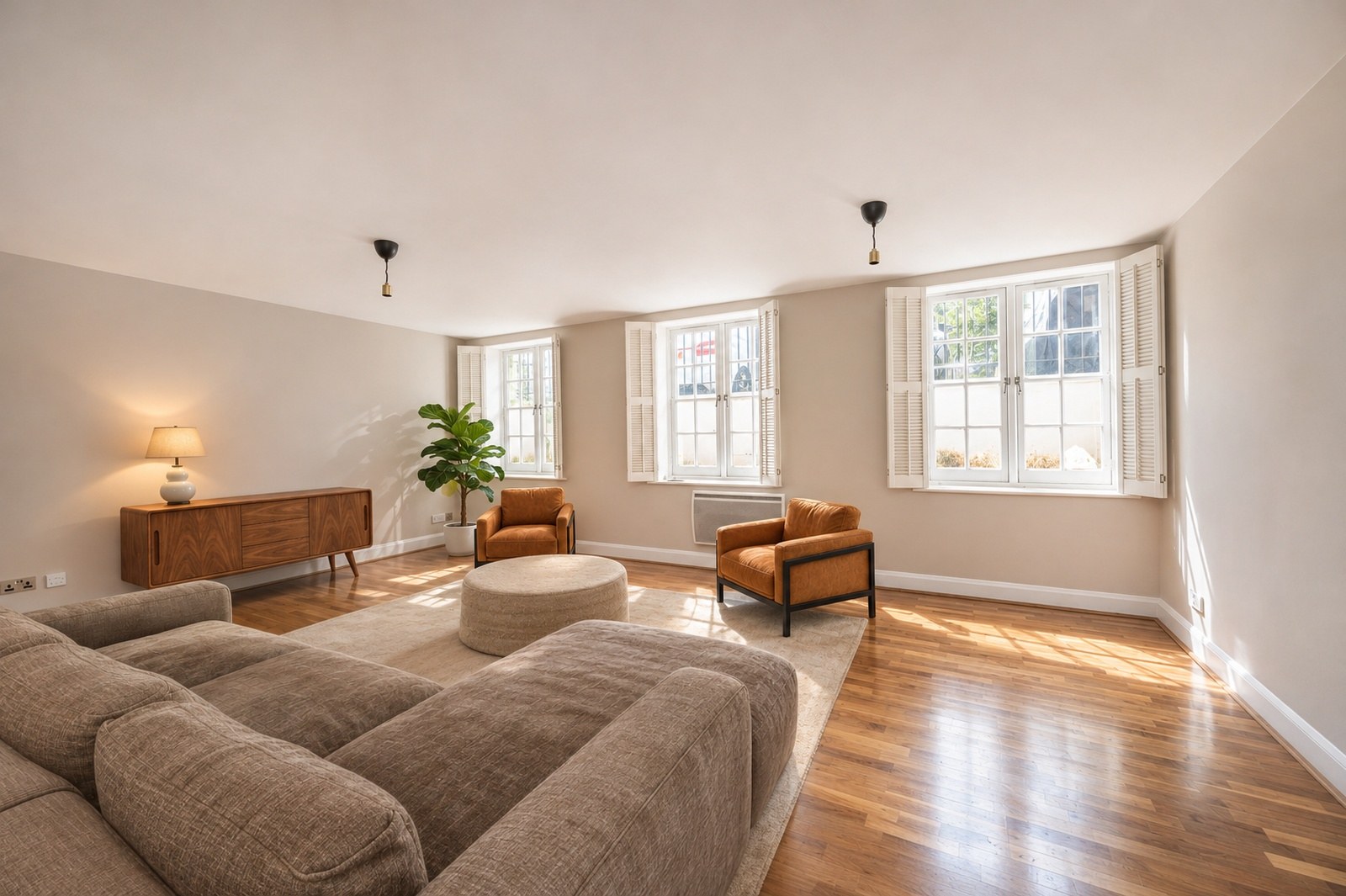
From the second angle the same pieces sit in the same places, which is the point of staging a room as a set: a buyer flicking between the two photos sees one room, furnished one way.
Common questions
Can I virtually stage a furnished room?
Yes. The owner's furniture can be removed digitally first, so a lived-in room can be shown empty or staged afresh. If the flat is let furnished, photograph the real furniture instead.
How long does virtual staging take?
AI software returns a room in minutes. Studios set their own turnaround, so ask when you request a quote.
Do I need the owner's permission to stage the photos?
We found no rule that asks for separate consent to stage. You already need the owner's agreement to market the property, which RERA's practice guide (opens in a new tab) calls Contract A: "An agreement to market a property between the seller and the real estate brokerage". Show the owner the staged set before it goes live, and check that your photographer's licence lets you edit the photos.
Does virtual staging work for rental listings?
Yes, for unfurnished lets. A rental advert needs a Trakheesi permit like a sale: Bayut's Trakheesi guide (opens in a new tab) lists the permit's purpose as "rent or sale". For a furnished let, the photos should show the furniture the tenant actually gets.
Can I use virtual staging in Abu Dhabi?
We found no Abu Dhabi rule on staged images either. Abu Dhabi runs its own permits: "Every online property advertisement must now obtain an advertising permit" through the Abu Dhabi Real Estate Centre's DARI portal before going live, for on-shore property for sale or rent, according to law firm Al Tamimi (opens in a new tab) (4 September 2025). Label staged photos and keep the originals there too.
Staging a room with Livium AI
Livium AI stages living rooms and bedrooms from up to six ordinary photos, with the same furniture in the same place in every photo of the room. Each staged photo downloads with a "Virtually staged" label or without one, and the original is always kept beside it. Anyone new with a confirmed email address gets 25 free credits, enough for a room of up to five photos, watermarked and with no card: start free.
Stage the room once.
Every photo matches.
Upload a few photos of the empty room. Livium AI furnishes it once, in one 3D model with every piece at its real size, so every photo of the listing shows the same furniture in the same place.
As photographedStaged by Livium AI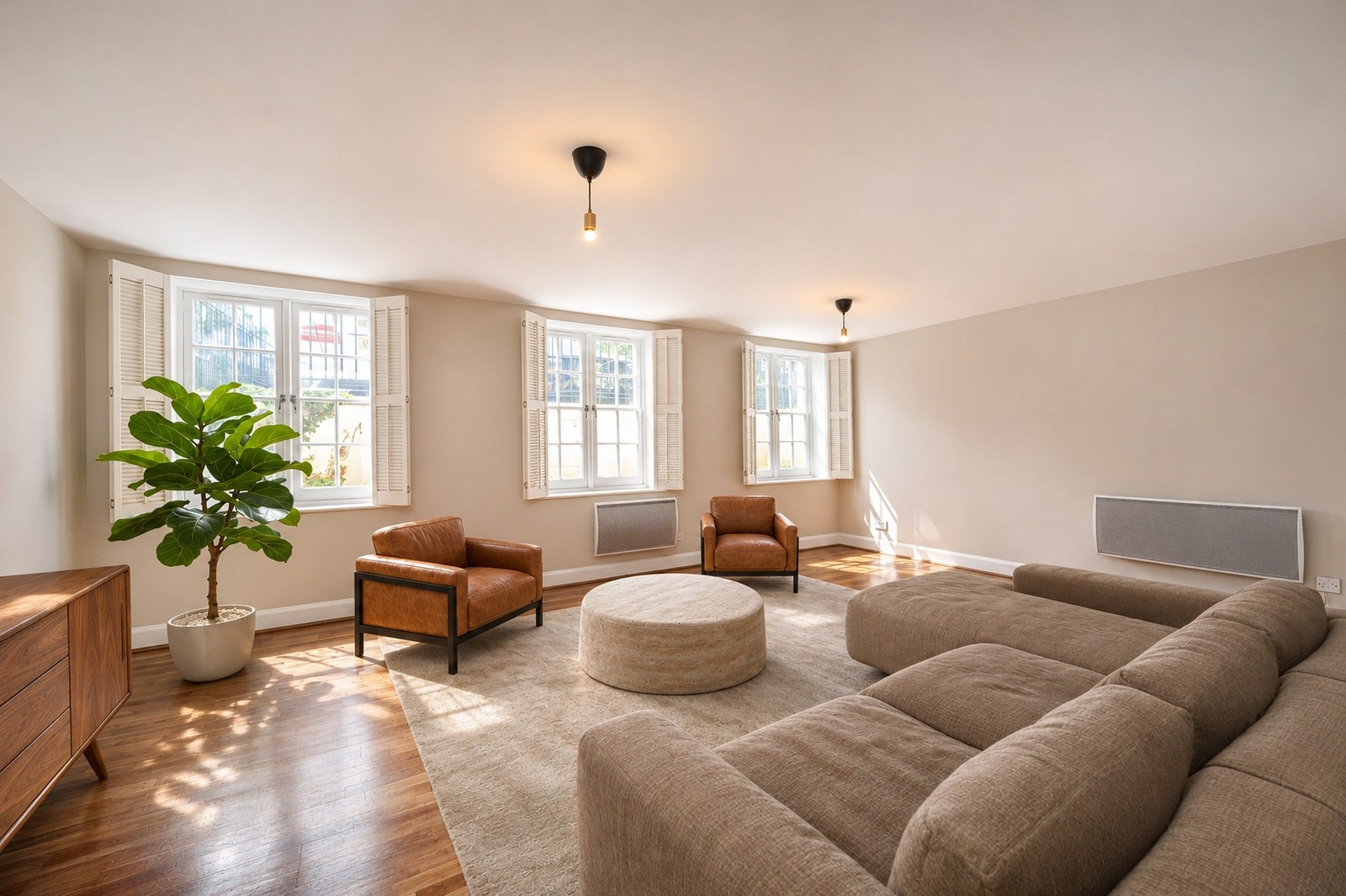
Sources
- Dubai's real estate market records new historic milestone with transactions exceeding AED917 billion in 2025 (opens in a new tab), Dubai Media Office, 12 January 2026
- Dubai's real estate brokerage sector witnessed a notable transformation in scale and impact in 2025 (opens in a new tab), Dubai Land Department, 9 March 2026
- Real Estate Brokerage Practice Guide, second edition (opens in a new tab), Real Estate Regulatory Agency, Dubai Land Department, November 2024
- Circular 2-2022: Real Estate ads terms and conditions (opens in a new tab), Real Estate Regulatory Agency, Dubai Land Department, 20 July 2022
- Complete Guide to the Trakheesi System in Dubai (opens in a new tab), Bayut, updated 16 November 2026
- Best practices for taking real estate listing photos (opens in a new tab), Bayut, updated 21 October 2026
- The Realtor's Guide To Staging A Home In The UAE (opens in a new tab), Bayut Agent Portal, 26 May 2023
- Do's and Don'ts of a Successful Home Staging in Dubai (opens in a new tab), Property Finder, 27 August 2025
- Property Finder Achieves 100 Percent DLD Compliance in Dubai, Strengthening Trust in the Real Estate Market (opens in a new tab), Property Finder, 20 November 2025
- Furniture and Home Staging directory (opens in a new tab), Real Estate Club Dubai, updated June 2026
- Dubai Furniture and Home Staging 2026 (opens in a new tab), Real Estate Club Dubai, undated, checked 16 November 2026
- Real Estate Photography Cost in Dubai 2026 (opens in a new tab), Real Estate Club Dubai, 15 June 2026
- Best Home Staging and Furniture Rental Companies in Dubai 2026 (opens in a new tab), Real Estate Club Dubai, 4 August 2026
- Home Staging in Dubai: Does it Increase Sale Price? (opens in a new tab), West Gate Real Estate, 7 June 2026
- Dubai Mandates Verified Accuracy for Virtual Property Tours (opens in a new tab), PropertyNews.ae, undated, checked 16 November 2026
- Pricing (opens in a new tab), Virtual Staging AI, checked 16 November 2026
- Abu Dhabi real estate: new transparency policies introduced by ADREC and ADGM (opens in a new tab), Al Tamimi and Company on Legal 500, 4 September 2025
Keep reading
How to sell or let a vacant apartment in Dubai
Selling or letting an empty flat in Dubai: the permit and owner's form, preparing and photographing the unit, staging options, and a checklist for the week.
Real estate photography cost in Dubai (2026 prices)
Real estate photography in Dubai costs about AED 350 to 800 for a one-bedroom on five studios' own price lists. Add-on prices, and what to ask before booking.
Home staging cost in Dubai: physical vs virtual
What home staging costs in Dubai: physical staging, furniture rental, studio virtual staging and software, priced in dirhams on one vacant one-bedroom.